
Bedtime stories for children aged 3–8 fall into distinct categories, each matched to a specific developmental stage, emotional state, and sleep goal. Choosing the right type of bedtime story is not about picking a favorite book at random. It shapes language skills, emotional regulation, and the quality of your child’s sleep transition. The types of bedtime stories for ages 3–8 range from rhythmic repetition tales for toddlers to narrative-driven adventures for early readers, and knowing which to reach for on any given night makes bedtime smoother for everyone.
1. Rhythmic and repetitive stories for ages 3–4
Rhythmic, repetitive stories are the single most effective story type for children aged 3–4. These books use echo pages, refrains, and chant-along phrases that invite children to participate rather than just listen. That participation is the point. When a child can predict and repeat a phrase, their brain is reinforcing language patterns in real time.
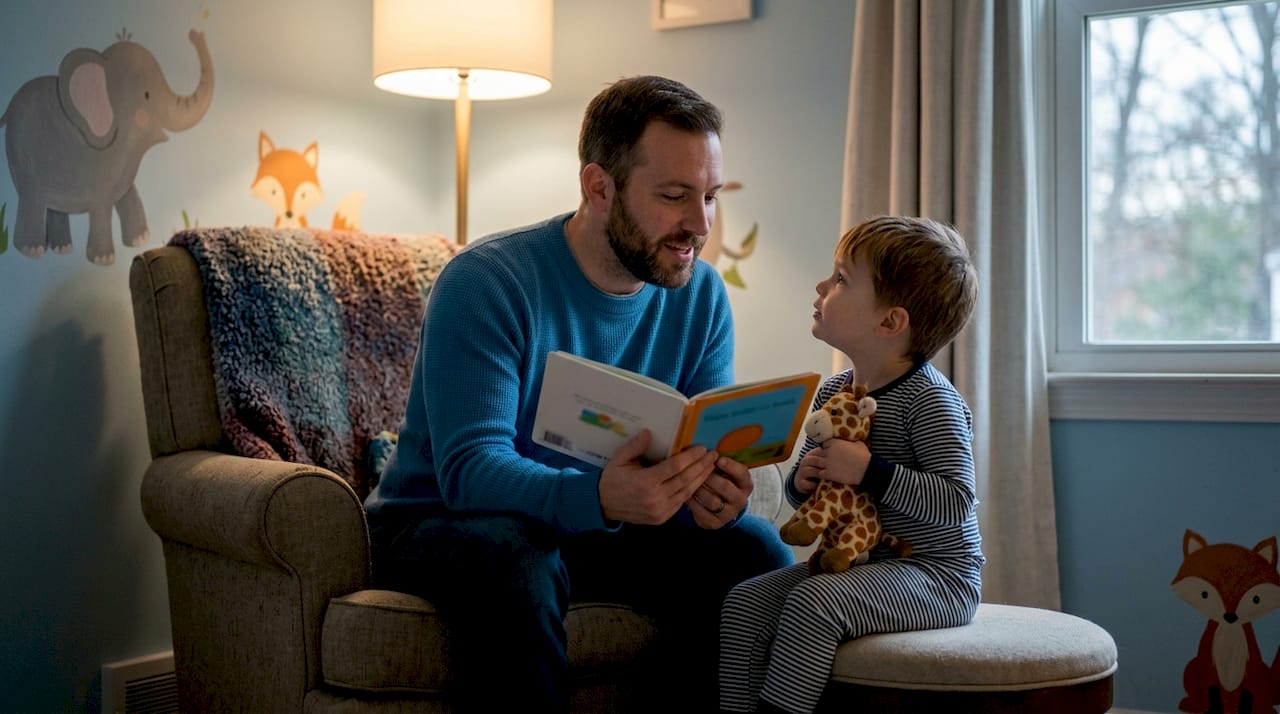
Repetition builds comprehension in younger children by giving them repeated exposure to sentence structures and vocabulary. Each time a phrase loops back, the child’s brain processes it more deeply. This is why toddlers ask for the same book night after night, and why that repetition is doing real developmental work.
Key features to look for in this story type:
- A single refrain repeated across every page spread
- Simple, predictable sentence structures (subject, verb, object)
- Soft, rhythmic pacing that slows the reading voice naturally
- Illustrations that mirror the text closely, reinforcing word-to-image connections
- A gentle, circular ending that returns to the opening scene
Pro Tip: Read the refrain slightly slower each time it appears. Your child’s body will physically slow down to match your pace, making the transition to sleep much easier.
2. Narrative-driven stories for ages 5–7
Narrative-driven bedtime stories are the right choice once a child starts asking “why.” Children aged 4 begin asking “why,” which signals the development of theory of mind, the ability to understand that other people have their own thoughts and feelings. By ages 5–7, children are ready for stories with clear character goals, rising stakes, and satisfying resolutions.
These stories do more than entertain. Narrative complexity supports cognitive and emotional growth by asking children to track a character’s inner life across multiple scenes. A child who wonders whether the hero will make it home is practicing empathy and prediction simultaneously.
What makes a strong narrative bedtime story for this age group:
- A main character with a clear, relatable goal (find the lost puppy, win the race, make a new friend)
- A single obstacle that creates genuine tension without being frightening
- A resolution that feels earned, not sudden
- Dialogue that reveals character, not just plot
- A story length of roughly 8–12 minutes read aloud
Children develop favorites they recall between readings, which means a well-chosen narrative story becomes a shared reference point for your family. You will hear your child mention the character at breakfast, which is a sign the story is doing its job.
Pro Tip: Pause before the resolution and ask your child, “What do you think happens next?” One question is enough. It deepens comprehension without extending bedtime.
3. Mood-matching stories based on your child’s energy level
The most overlooked variable in bedtime reading is your child’s energy level at the moment you open the book. A wired child benefits from funny or physical stories, while a drowsy child needs rhythmic, calming stories. Applying the wrong story type to the wrong energy state makes bedtime harder, not easier.
The practical solution is the “two short” story rule. Two 3-minute stories work better than one 10-minute story for settling children under six. The first story meets the child where they are. The second story brings them down.
Here is how to apply this in practice:
- Read the room before you open any book. Is your child bouncing, laughing, or talking fast? That is a wired state.
- For a wired child, start with a funny or mildly adventurous story that acknowledges their energy.
- Follow immediately with a slow, rhythmic story that signals the shift to sleep.
- For a drowsy child, skip the first story entirely and go straight to the calming option.
- Keep total reading time to 7–10 minutes regardless of which combination you use.
“Parents often mistakenly over-stimulate children before sleep with high-energy stories. The ‘two short’ rule helps bring down energy effectively.”
Matching story choice to your child’s mood is a skill that takes about a week to develop. Once you recognize the patterns, you will rarely have a difficult bedtime again.
4. Mindfulness and cosmic-themed stories for calming
Mindfulness and cosmic-themed stories are among the most effective calming tools for children aged 4–8. Stories about stars, gravity, and constellations foster slow, reflective pacing that naturally slows a child’s breathing and mental activity. The subject matter itself does the work. A child imagining the distance between stars cannot stay anxious about tomorrow’s playdate.
Mindfulness and cosmic-themed stories invite slower pacing and physical relaxation for children in this age range. The key is choosing stories where the wonder is quiet rather than exciting. A book about how clouds form is calming. A book about a rocket chase is not, even if it features space.
Look for these qualities in a calming story:
- Descriptive language that focuses on textures, sounds, and sensations
- A child or animal character who is settling, resting, or observing
- No plot twist or surprise in the final third of the book
- Illustrations in cool colors (blues, greens, deep purples) rather than warm, stimulating tones
Pro Tip: Read cosmic and mindfulness stories in a lower register than your normal speaking voice. The physical act of lowering your voice slows your own breathing, and your child will mirror it.
5. Short bedtime tales and “anchor” stories as developmental staples
Short bedtime tales are defined as stories that can be read in 3–5 minutes and contain a small moral with no loud or exciting moments. Gentle stories with limited adventures help emotional regulation before sleep by keeping the nervous system calm rather than stimulated. These are not lesser stories. They are precisely calibrated for the job.
“Anchor” books are the specific titles your child returns to obsessively. Returning to the same anchor book is a necessary developmental stage that builds language skills and confidence. Each re-reading allows the child to notice new details and feel the satisfaction of knowing the outcome. That sense of mastery is genuinely calming.
Recommended story lengths by age:
| Age | Ideal story length | Number of stories per night |
|---|---|---|
| 3–4 years | 3–5 minutes | 2 short stories |
| 5–6 years | 5–8 minutes | 1–2 stories |
| 7–8 years | 8–12 minutes | 1 story |
Practical ways to keep anchor stories fresh without abandoning them:
- Change your reading voice for different characters each time
- Ask one new question per reading (“Did you notice what color the door was?”)
- Let your child “read” the familiar pages back to you from memory
- Rotate the anchor book with a new title every two weeks, then bring it back
Ending every session with a fixed ritual phrase like “The end. Time to dream.” primes your child’s body and mind for rest. Consistent ritual phrases aid in sleep readiness by creating a clear psychological signal that interaction is over and sleep begins. Use the same phrase every night without variation.
Pro Tip: Let your child choose the anchor book, but you choose the calming story. This split gives them control over the fun part while you manage the sleep transition.
6. Stories about complex feelings for emotional processing
Stories that center on complex feelings serve a specific function at bedtime. Stories about complex feelings help children process their day’s emotions by showing characters experiencing similar situations. A child who felt left out at school finds relief in a character who navigates the same feeling and comes through it. That recognition is not incidental. It is the entire value of the story.
This story type works best for children aged 5–8, who have enough emotional vocabulary to connect a character’s experience to their own. Keep the emotional content moderate. A story about feeling nervous before a recital is appropriate. A story about grief or serious loss is not a bedtime choice for most children in this age range.
The best emotional-processing stories share three traits. The character names the feeling clearly. The story shows the feeling passing rather than resolving through a dramatic fix. The ending is peaceful, not triumphant.
Key takeaways
The most effective bedtime reading strategy matches story type to your child’s age, energy level, and emotional state every single night.
| Point | Details |
|---|---|
| Match story to age | Use rhythmic repetition for ages 3–4 and narrative-driven stories for ages 5–7. |
| Use the two-story rule | Two 3-minute stories settle children under six better than one long story. |
| Read the energy level | A wired child needs a funny story first; a drowsy child goes straight to calming. |
| Anchor books build skills | Repeated reading of the same book builds language mastery and confidence. |
| End with a ritual phrase | A fixed closing phrase like “The end. Time to dream.” signals sleep every night. |
What I have learned from watching bedtime routines up close
The single mistake I see parents make most often is treating bedtime stories as a reward rather than a tool. When the story becomes a negotiation, the child controls the transition. When it becomes a ritual, the child relaxes into it.
The parents who report the smoothest bedtimes are not the ones with the biggest book collections. They are the ones who read the same three books in the same order for six months straight. That consistency feels boring to adults. To a child aged 3–6, it is deeply reassuring. The brain does not want novelty at bedtime. It wants to know what comes next.
I have also noticed that parents who switch story types based on their child’s energy, rather than their own preference, get children to sleep faster. A tired parent reaching for a long, complex story because they enjoy it is working against the child’s biology. Two short, well-chosen stories beat one long favorite almost every time.
The other thing worth saying plainly: your voice matters more than the book. A calm, slow reading voice on a mediocre story will outperform an anxious, rushed reading of a perfect book. The story is the vehicle. You are the destination.
— Standley
Personalized bedtime stories that grow with your child
Every story type covered here works better when your child sees themselves in the main character. Dreamseedbooks builds personalized storybooks that incorporate your child’s name, appearance, and favorite themes into a custom 20+ page illustrated book. Each book is reviewed by a real person before delivery, so the personalization is accurate, not just a name swap.
For parents focused on calming bedtime transitions, the Calm Goodnight Adventure puts your child at the center of a mindfulness-themed story designed specifically for ages 3–8. For children aged 5–7 who are ready for narrative-driven plots, the child-as-hero storybook delivers the character stakes and resolution that this age group needs. Both arrive digitally within 24 hours.
FAQ
What types of bedtime stories work best for ages 3–4?
Rhythmic, repetitive stories with refrains and echo pages work best for ages 3–4. These stories build language patterns and invite participation, which supports comprehension and eases the transition to sleep.
How long should a bedtime story be for a 5-year-old?
A bedtime story for a 5-year-old should run 5–8 minutes read aloud. Two shorter stories totaling 7–10 minutes often work better than one longer story for children under six.
Why does my child want the same book every night?
Returning to the same anchor book is a normal developmental stage. Repeated reading builds language mastery, confidence, and the calming sense of knowing what comes next.
What are the best bedtime story themes for preschoolers?
Calming themes like nature, animals settling for the night, and simple friendship work best for preschoolers. Avoid stories with loud moments, surprises, or unresolved tension in the final pages.
How do I choose a bedtime story based on my child’s mood?
Match the story to your child’s energy level. A wired child benefits from one short, funny story followed by a calming rhythmic story. A drowsy child goes straight to the slow, repetitive option.